The 1986 World Champion New York Mets — A Legacy Moment at the Nick Loeb Foundation’s 5th Annual Party with the Police
Written and hosted by Reginald V. Armstrong · World Baseball Network
The Day, the Estate, the Purpose
For the second consecutive year, I had the privilege of hosting a live baseball conversation on behalf of The World Baseball Network at The Nick Loeb Foundation’s Party with the Police: BBQ & Pool Party — a staged summer gathering held in Purchase, New York, approximately 29 miles north of Madison Square Garden. The event has become one of the most meaningful fixtures in this part of Westchester County. Returning to the sprawling grounds felt like stepping back into a familiar chapter: families moving easily across the lawn, children darting toward the waterslide and the zip line, and the unmistakable hum of community that gives this day its soul.
Across the estate, local-area businesses had set up exhibits offering culinary delights, wines, beverages, and summer fare. Music drifted through the grounds, blending with laughter, conversation, and the energy of a community gathered with purpose. And on the property sits a full baseball field, where our distinguished guests, adults, and children alike took batting practice and fielded fly balls and grounders throughout the afternoon.
Even elected officials were present — including Bruce Blakeman, the two-term Nassau County Executive, on hand as he campaigns for the New York gubernatorial seat, and with whom I had the pleasure to speak.
It was a scene of joy — but joy with intention.
Because the purpose of this event is not ceremonial. It is essential.
The Foundation’s work centers on supporting the families of local-area police officers — especially those who do not possess the means to send their children to top-drawer or out-of-state schools, and who often fall into the gap where financial aid does not reach. This fundraiser exists to close that gap. To ensure that the children of those communities have access to the educational futures they deserve.
It is a mission rooted in gratitude, service, and opportunity — values that run deep in the Loeb family’s history.
The Loeb Lineage — Enterprise, Diplomacy, and Philanthropy
The story begins with Carl M. Loeb, born in Frankfurt in 1875, who immigrated to the United States and rose to prominence as president of the American Metal Company. In 1931, Carl and his son John Langeloth Loeb Sr. founded Carl M. Loeb & Co., a firm that would soon become a pillar of American finance. In 1937, the firm merged with Rhoades & Company to form Loeb, Rhoades & Co., one of Wall Street’s most influential investment houses of the mid-20th century.
John L. Loeb Sr. would go on to serve as senior partner and later president of the firm, steering it through major expansions and mergers — including the formation of Loeb, Rhoades, Hornblower & Co., and ultimately Shearson Loeb Rhoades in 1979.
His son, John Langeloth Loeb Jr., continued the family’s legacy of service — appointed by President Ronald Reagan as United States Ambassador to Denmark from 1981 to 1983, and later serving as U.S. Representative to the United Nations Human Rights Commission.
Today, that tradition continues through his son, Nick Loeb, whose stewardship of the Foundation and this annual fundraiser reflects the same commitment to service and community that has defined the Loeb family for generations.
And on this particular afternoon, woven into the fabric of the day was something else entirely: a moment of baseball history, carried by three men whose names still echo across the decades:
Wally Backman.
Lenny Dykstra.
Dwight “Doc” Gooden.
Three pillars of the 1986 World Champion New York Mets — a team that didn’t just win a championship but captured the soul of New York City. A team whose legacy, forty years later, remains one of the most powerful in sports. A team whose story is as much cultural as it is athletic.
This written legacy edition presents the full version of the event as originally designed — the complete historical arc, the full standup, the full narrative, and the full story of the ’86 Mets. The video companion captures portions of the live panel; this written edition preserves the entire planned journey.
The Architect — Frank Cashen
Before the Mets’ rise could begin, the franchise needed an identity — a philosophy strong enough to rebuild a culture and disciplined enough to sustain it. That identity arrived in 1980 with the hiring of Frank Cashen, the executive who had helped build the Baltimore Orioles into one of baseball’s model organizations.
Cashen brought with him the principles that defined what became known as The Oriole Way: player development rooted in discipline; organizational alignment from scouting to the major league roster; accountability inside the clubhouse; and a belief that culture is not ornamental — it is structural. He did not import slogans. He imported architecture. And that architecture became the foundation of the Mets’ ascent.
The Davey Johnson Connection
Cashen’s decision to hire Davey Johnson as manager for the 1984 season was not incidental. Johnson had been an excellent second baseman for those very Orioles — a product of the same system Cashen helped shape. Their shared history mattered. Their shared philosophy mattered. Their shared understanding of how to build a winning culture mattered.
Davey was not hired to manage a roster. He was hired to complete a construction project.
Wally Backman’s Reflections
Wally Backman speaks glowingly of Cashen — not just as an executive, but as a presence. Even after Wally’s playing days, when he transitioned into coaching, Cashen remained a steadying force. That relationship is part of the cultural fabric of the era: Cashen respected competitors, and competitors respected Cashen.
He wasn’t simply the general manager.
He was the architect of the Mets’ identity.
The Climb — 1985
The year that stung — and the fuel that ignited 1986.
By 1985, Frank Cashen’s architecture was fully in place. The culture was aligned, the roster was mature, and the Mets were no longer a rising team — they were a force. The season produced 98 wins, a total that would have secured a division title in almost any other era. But in a pre-wild-card world, 98 wasn’t enough. The Mets finished three games behind St. Louis, a margin so narrow it became part of the mythology of what came next.
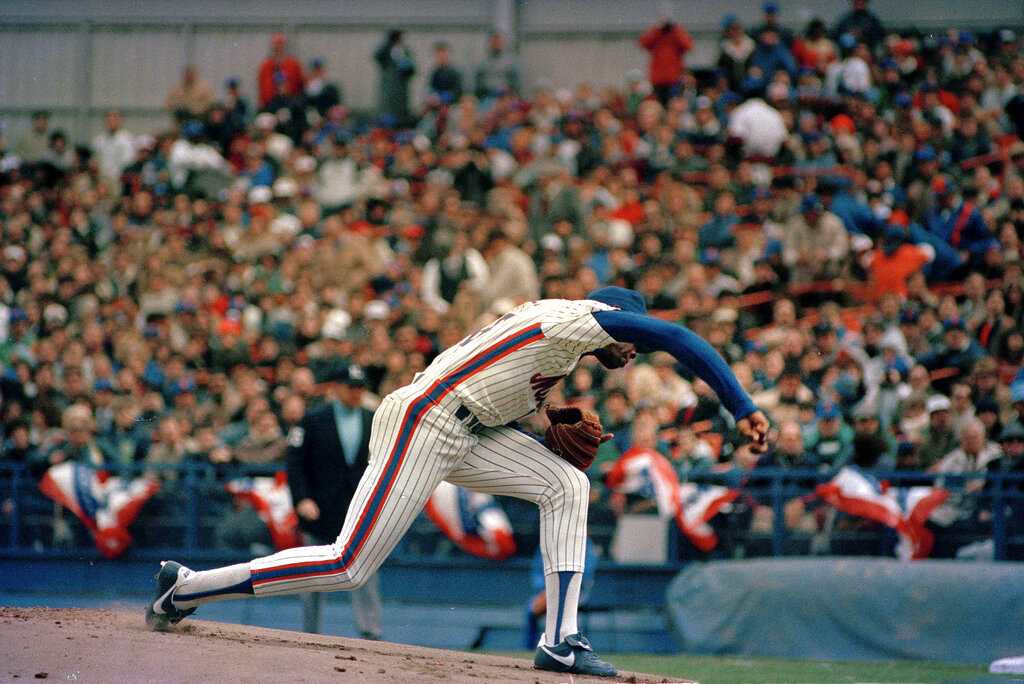
Dwight Gooden of the New York Mets pitches in the opening day game against the St. Louis Cardinals at New York’s Shea Stadium, April 9, 1985. (AP Photo/Ray Stubblebine)
Doc Gooden’s Historic Season
Dwight Gooden’s 1985 campaign remains one of the most dominant pitching seasons in modern baseball history — a statistical monolith that defined the team’s identity:
- 24–4 record
- 1.53 ERA
- 268 strikeouts
- 0.97 WHIP
- 16 complete games
- 8 shutouts
- Cy Young Award
- Triple Crown in ERA, wins, and strikeouts
It was dominance so complete that it became part of the clubhouse’s internal language. During the panel, Doc himself recalled one of Wally Backman’s classic lines from that season. The Mets won 98 games but finished three behind St. Louis. Doc noted that Wally, with perfect timing, once joked that if Doc hadn’t lost his mere four decisions, the Mets “would have been in it.” The four of us on the outdoor stage chuckled — because he was very nearly right, and the humor captured just how close the Mets were to breaking through.
The Sting That Became Fuel
1985 ended with a bruise — the kind that lingers, sharpens focus, and hardens resolve. Inside the clubhouse, the feeling was simple:
We’re ready.
Now we finish.
1985 wasn’t a prelude. It was the spark.
The Summit — 1986
The year the architecture, the culture, and the men reached their apex.
The 1986 Mets did not open the season as a juggernaut. They opened it 2–3, a start that lasted only long enough to remind the clubhouse of unfinished business. What followed was the first unmistakable sign of the team’s competitive force. From April 18 through April 30, the Mets won 11 straight, their longest winning streak of the season. By April 22, already sitting atop the NL East, the team’s posture had sharpened. The clubhouse carried itself with a confidence that matched the city’s expectations. The Mets were no longer gathering momentum — they were asserting control.
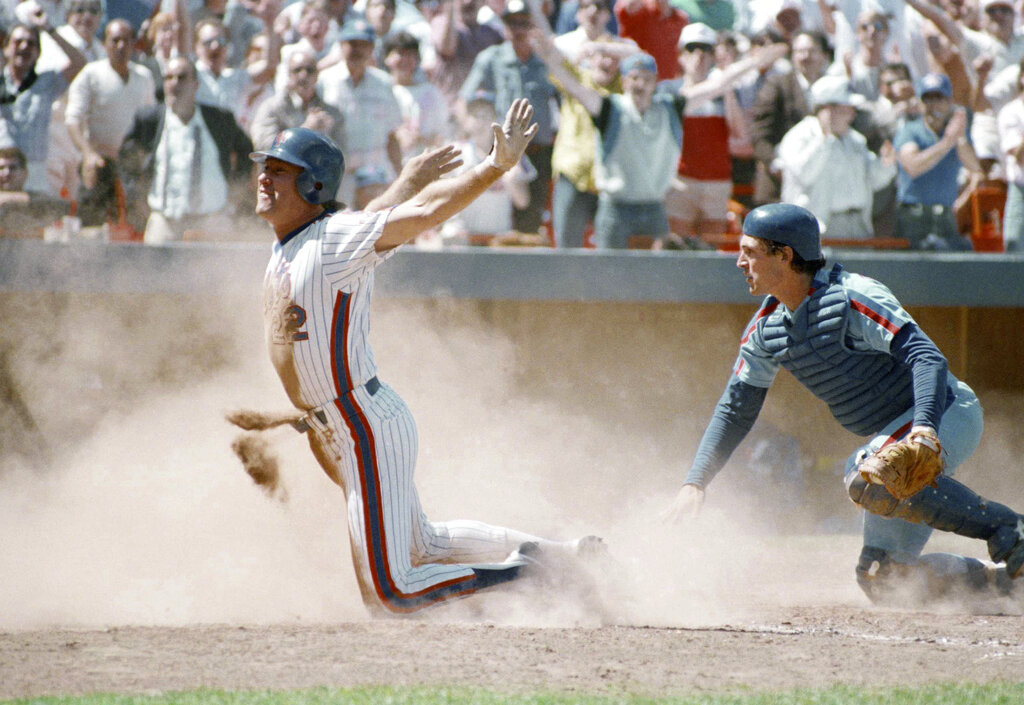
Ray Knight, left, of the New York Mets emerges jubilant from a cloud of dust at home plate after the umpire ruled him safe on a close play in the fourth inning of a game against the Expos at Shea Stadium, Wednesday, June 25, 1986, New York. Knight scored the go-ahead run in the Mets 5-2 win on a hit by Sid Fernandez. The catcher is unidentified. (AP Photo/Ray Stubblebine)
What made that posture possible was the architecture Frank Cashen had spent six years constructing. The roster was no longer young talent searching for identity — it was a balanced, seasoned, and fully realized machine. Keith Hernandez and Gary Carter formed the leadership spine, the competitive conscience of the clubhouse, and the stabilizing force behind a rotation loaded with youth and electricity. Doc, Ron Darling, and Sid Fernandez all benefited from their presence — from tempo, from game management, from the daily standards Keith and Gary imposed. And when Bob Ojeda arrived from Boston, he brought the final ingredient the staff needed: veteran calm, innings, and edge.
The lineup reflected the same balance. Pressure at the top. Power in the middle. Depth everywhere. Darryl Strawberry supplied the game-breaking force — the swing that bent ballparks, the presence that altered pitching plans, the threat that changed the temperature of every inning he occupied. Behind him sat a bench that mattered — Dave Magadan, Kevin Mitchell, Lee Mazzilli, Danny Heep — the kind of roster density that allowed Davey Johnson, the ultimate players’ manager, to deploy every man with purpose. In the bullpen, Jesse Orosco and Roger McDowell formed a two-headed anchor, closing games with contrasting styles and shared conviction. Every lane had definition. Every role had clarity. Every night had a plan.
By mid-June, the standings began to reflect what the clubhouse already knew. After June 14, the Mets held a double-digit lead in the NL East for all but one week for the rest of the regular season. They never lost more than four games in a row all year — and only twice. Every series carried the weight of inevitability. The identity built over six years — architecture, culture, competitive fire — was now fully visible.
By the time the Mets reached September 17, the regular season had already taken on the shape of a coronation. They were 95–50 and 19 games ahead of the Phillies. Shea Stadium didn’t arrive at that night with nerves — it arrived with certainty. The crowd understood what was coming. The clubhouse understood what was coming. The city understood what was coming.
Gooden took the ball against the Chicago Cubs and delivered the kind of performance that defined his presence in that era — a complete game, beating Dennis Eckersley 4–2, commanding and controlling tempo throughout. It was calm, forceful, and inevitable — the perfect reflection of the season he anchored.
At the top of the lineup, Dykstra did what he had done all year: apply pressure from the first pitch, turning the top of the order into a weapon and forcing opponents into defensive urgency from the opening inning. Backman matched that energy — the same chaos, tempo, and competitive fire that defined the Mets’ identity all season.
And down the stretch came Magadan — booed only because he was announced as Hernandez’s stand-in at first base on the clinching night — answering the moment with three hits and two RBI. On a night built on inevitability, Magadan delivered the unexpected: a reminder of the depth Cashen constructed and the culture that allowed every man to matter.
When the final out settled into a glove, Shea Stadium erupted into mayhem. The Mets had won their first division title since 1973, and they had done it in a fashion that matched the architecture of their rise. This wasn’t a chase. This wasn’t a surprise. This wasn’t a miracle. It was the night inevitability became official.
They finished the regular season 108–54, one of the most dominant records in modern National League history, and ended the year 21.5 games ahead of the second-place Phillies — a margin that did not simply reflect superiority. It reflected inevitability.
The 1986 Mets were the culmination of Cashen’s architecture, Davey’s leadership, the competitive heartbeat of Backman, the ignition of Dykstra, the phenomenon of Gooden, the force of Strawberry, the seasoning of Ojeda, the depth of the roster, the scars of 1985, and the force of New York.
They were not a team that happened to win.
They were a team constructed to win.
The NLCS — Houston, the October Gauntlet
The National League Championship Series was not a matchup. It was a collision. Houston arrived engineered for October — a rotation built on power and deception, a bullpen that closed games with ice, and a ballpark whose heavy air turned every run into a fistfight. The Mets had dominated the regular season, but the NLCS demanded something different: endurance, pressure, and the ability to survive games that felt like they might never end.
The Astros’ identity began with Mike Scott, whose splitter was at the peak of its powers. His presence alone altered the psychology of the series. Opponents didn’t just prepare for him — they braced for him. Alongside Scott stood Nolan Ryan, still throwing lightning, and Dave Smith, whose ninth-inning composure made every lead feel larger than it was. And then there was the Astrodome — a building that swallowed fly balls and punished mistakes. The Mets knew they were entering a fight.
For Dykstra, the turning point came in Game 3 at Shea. Bottom of the ninth, Dave Smith on the mound, the series even at a game apiece. Dykstra stepped in and delivered one of the defining swings of the postseason — a walk-off home run that flipped the entire temperature of the series. It was the kind of moment that changes a clubhouse. The Mets didn’t just win a game; they seized momentum. Dykstra’s swing became the ignition point for everything that followed.
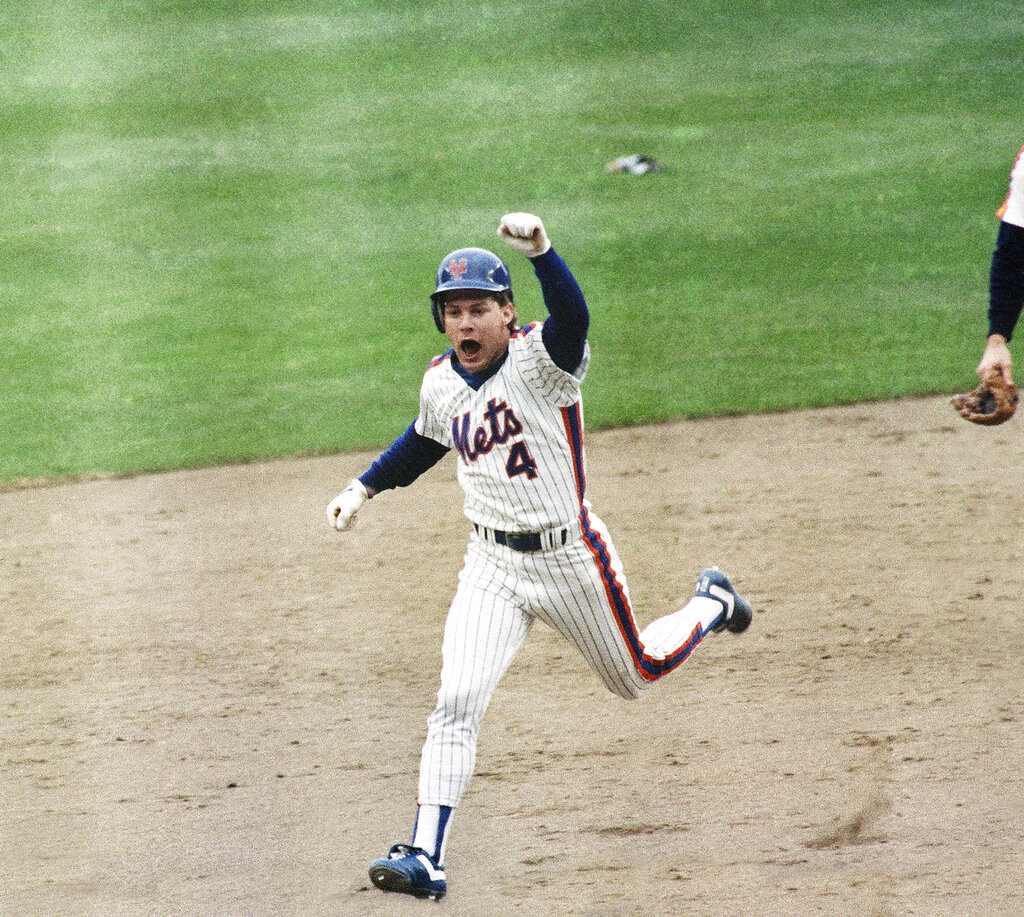
Lenny Dykstra of the New York Mets thrusts a fist in the air as he rounds the bases after his game-winning two-run homerun in the bottom of the ninth inning of Game 3 of the National League Championship Series against the Houston Astros, Saturday, Oct. 11, 1986, New York. The homer scored Wally Backman and beat Houston 6-5. (AP Photo/G. Paul Burnett)
Wally’s NLCS was a study in pressure. He kept innings alive, moved runners, and played flawless defense. In a series where every run felt like a negotiation, Backman’s ability to manufacture chaos mattered. He and Dykstra applied pressure throughout the series, forcing Houston’s staff into situations they didn’t want to defend. Backman’s contributions weren’t loud — they were structural.
Doc’s role was different. He became the counterweight to Scott. Across seventeen magnificent innings, Gooden allowed only two earned runs — seven innings of brilliance in Game 1, where Scott’s 14-strikeout, complete-game masterpiece stole the result, and a Game 5 start against Ryan that stretched into a 12-inning classic and became one of the great pressure performances of his career. Gooden didn’t overpower the Astros — he outlasted them.